Sunscreen
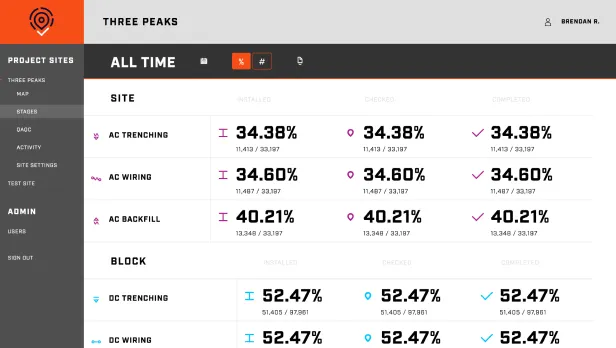
A digital solution to a paper problem. We built the web application and API powering iPad and desktop tools used for managing QA on large-scale solar projects.


The Dessy Group, founded in 1939, is a multigenerational juggernaut of the bridesmaid industry. When a company has been dressing wedding parties since before World War II, its operations run deep: an established wholesale business, a large product catalog, and enterprise systems that the whole operation depends on.
This project was the brainchild of SKU Agency, who provided the initial concept, design, strategy, and client communication. Their vision for the Dessy Partner Program: a network of satellite Shopify stores selling Dessy products, each one provisioned with its own highly customized theme, all fed and reconciled from Dessy’s central systems. SKU brought us on to architect and build the software that would make that possible.
Launching one e-commerce store is a well-worn path. Launching dozens of them, keeping every one stocked with an accurate catalog, and flowing every order back into the systems that run the wholesale business is a different kind of problem entirely.
Dessy’s product data lived where it had always lived: in the Dessy product feed and a BlueCherry ERP system, both built around the needs of a wholesale operation. Shopify has firm opinions about how products, variants, and options should be structured, and a wholesale product feed has entirely different ones. Reconciling the two meant adapting the Dessy feed for use on Shopify. The sync also had to run in both directions: products and updates flowing out to each store, orders flowing back into the ERP, continuously and correctly, across the entire store network.
There was an operational problem stacked on top of the data problem. Provisioning a partner store by hand took weeks or months of setup work. At that pace, the program could never scale past a handful of stores. For the Partner Program to work as a business, store creation had to get close to push-button.
We architected and built a custom Ruby on Rails application from scratch to act as the hub of the entire program: one application providing 2-way sync between Shopify, the Dessy product feed, and the BlueCherry ERP system, along with the ability to provision each satellite store with a highly customized theme.
The architecture is headless by design. The Rails application owns the canonical state and does the orchestration, and each Shopify store hangs off it as a spoke. That structure is what lets one application manage dozens of stores without the whole arrangement collapsing into a tangle of per-store special cases.
The mechanics underneath follow from the shape of the problem. Syncing thousands of products and orders between systems is background-job work, so Sidekiq queues carry the sync while PostgreSQL holds the canonical data. Work that moves through queues can be retried, monitored, and scaled, which is exactly what a continuous 2-way sync needs. And because a bug in this kind of system would surface as a wrong product on a live store or a missing order in the ERP rather than as an obvious error page, we covered the application with an RSpec test suite from the start and still ship changes through it.
The feed adaptation work deserves its own mention. Getting a wholesale product catalog to present itself correctly as dozens of consumer-facing Shopify catalogs meant solving the mismatch between the two systems product by product, edge case by edge case, until the pipeline could be trusted to run without a human checking its work.
Store provisioning got the same treatment as the sync: automate everything that can be automated. The application spins up a fully-functioning custom Shopify store filled with products, applies the customized theme, and leaves only the genuinely human decisions to the SKU team. We also built a custom dashboard providing insights on sales volume across the store network, so the program’s performance is visible in one place instead of scattered across dozens of Shopify admin panels.
We automated about 90% of the store creation workflow. The SKU team can now spin up a fully-functioning custom Shopify store filled with products in days, as opposed to the weeks or months the manual process demanded. That difference is what turned the Partner Program from an idea into an operating network.
Today the platform syncs thousands of orders and products across dozens of Shopify stores, and the program has resulted in thousands of orders for Dessy products. The application runs quietly in the background the way good integration software should: stores stay stocked, orders reach the ERP, and the people involved get to think about the bridesmaid business instead of the plumbing.
For a company founded in 1939, the Dessy Partner Program extended an established business into a new sales channel.
Read more about the Dessy Partner Program in Vows Magazine.
 Ruby on Rails
 PostgreSQL
 Sidekiq
 Rspec
Rspec
 Shopify
A digital solution to a paper problem. We built the web application and API powering iPad and desktop tools used for managing QA on large-scale solar projects.